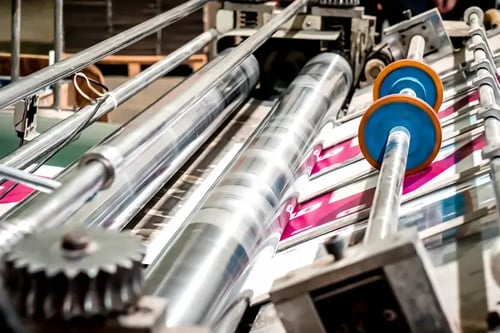
Pulley wobble is one of the most common—and costly—mechanical issues in high-speed printing equipment. What often starts as a subtle vibration can quickly escalate into poor print quality, increased maintenance, and unplanned downtime. For printers operating at tight tolerances and high line speeds, even small alignment errors can have an outsized impact.
Understanding the root cause of pulley wobble—and how to eliminate it at the design level—is key to improving both performance and reliability.
Why Pulley Wobble Happens in Printing Equipment
In many printing applications, pulley wobble is traced back to press-fit, two-piece pulley designs. While common, these assemblies introduce inherent variability during installation and over time.
Key contributors include:
-
Misalignment during press fitting
-
Uneven material stress between components
-
Stack-up tolerances between hubs, shafts, and flanges
-
Total Indicator Runout (TIR) that increases with wear
As line speeds increase, these variables compound, leading to vibration that directly affects print registration, consistency, and surface quality.
The Hidden Cost of TIR (Total Indicator Runout)
TIR is often underestimated until it becomes a production issue. Excessive TIR introduces cyclical motion into the drive system, which manifests as:
-
Visible wobble
-
Increased vibration
-
Accelerated bearing and belt wear
-
Frequent operator adjustments
-
Inconsistent print output
In continuous production environments, these effects disrupt uptime and place unnecessary strain on both equipment and personnel.
Why Press-Fit Pulleys Struggle at High Speeds
Press-fit pulleys rely on interference fits to maintain alignment, but no two presses—or operators—are exactly the same. Over time, thermal cycling, load changes, and vibration can shift components just enough to create imbalance.
For high-speed printing equipment, this design simply lacks the consistency required to maintain long-term stability.
The Engineering Solution: One-Piece Pulley Design
The most effective way to eliminate pulley wobble is to remove the source of misalignment entirely.
B&B Manufacturing addressed this issue by engineering a true one-piece pulley, designed and manufactured to maintain concentricity from the start. By eliminating press-fit assemblies, the pulley becomes a single, unified component—machined for precision and balance.
In-House Manufacturing Precision
Each one-piece pulley is produced entirely in-house using advanced machining methods, including:
-
Hobbing for precise and repeatable tooth profiles
-
Shaper cutting to accommodate complex geometries
-
360° roll-formed flanges for full-contact stability and strength
This level of control ensures minimal TIR, consistent performance, and long-term reliability in demanding printing applications.
Real-World Results in Printing Applications
When a printing customer experiencing persistent wobble and vibration replaced their press-fit pulley with a one-piece design, the results were immediate:
-
TIR-related wobble was eliminated
-
Machine operation became smooth and stable
-
Vibration was significantly reduced
-
Print quality noticeably improved
-
Operator intervention dropped dramatically
-
Reliability increased for continuous production
Rather than reacting to symptoms, the issue was solved at the source.
When Should You Rethink Your Pulley Design?
If your printing equipment is experiencing:
-
Repeating vibration issues
-
Declining print consistency at higher speeds
-
Frequent realignment or maintenance
-
Premature belt or bearing wear
…it may be time to evaluate whether your pulley design is truly suited for high-speed operation.
Engineered Motion Solutions That Perform
At Solve Industrial Motion Group, B&B Manufacturing delivers engineered pulley solutions designed to prevent issues before they disrupt production. By combining deep application expertise with precision manufacturing, customers receive components built to perform reliably in real-world conditions.
Pulley wobble isn’t inevitable. With the right engineering approach, it can be designed out entirely.